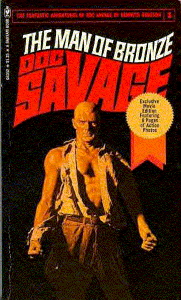
Doc Savage |
by Arthur C. Sippo MD, MPH
Doc Savage |
Editor's Note: Before reading Further Thoughts on the Doc Savage Chronology, the interested reader may find it useful to read The Doc Savage Chronology.
1869 - James Clarke Wilder is born as the illegitimate son of
the Duke of Holdernesse (aka the 6th Duke of Greystoke) and
Patricia Clarke Wilder.
1884 - James is physically and mentally precocious. He is
initially educated at Eton where he first meets and be friends
the American Hubert Robertson who is also studying there. Because
of his illegitimacy, James was sent to America by his father to
attend University. He matriculated at Harvard University
along with Robertson. James studied both the hard sciences
and business. While in America, he met several of his mother's
relatives from Canada and the United States. One distant
cousin was Richard Henry Savage. The older man became a
mentor to young James and they often traveled together posing as
father and son. Wilder assumed the pseudonym "Clark
Savage" during these trips.
During this time, he also became acquainted with the extended
eugenics program of the Howard Foundation, which has been
documented by Robert Heinlein in his Lazarus Long stories.
The Wilder family in America was part of the program and as both
a Wilder and a descendent of the notorious William Cecil Clayton,
James Wilder qualified for participation. He was reticent
about becoming involved with them but his curiosity was piqued
and he decided to study medicine in order to better understand
human longevity. One of the people he met in the Howard
Foundation was a young German physician, Gunter Asch who had come
to America to study the Howard breeding program.
1888 - Wilder was accepted into the Johns Hopkins Medical
School. In his 3rd year, he became aware of his father's
serious financial problems when his tuition was not paid.
James left school and went to Canada to supervise his father's
holdings there in the hopes of reversing the family's fortunes.
1895 - James Wilder disappeared and his father, the Duke, came to
Canada in order to find him. One of the people assisting
him was Ned Land. These events are documented in Ian
Cameron's novel "The Lost Ones." The book claimed
that the story occurred in 1958. This is actually an
anagram for 1895. (This book was made into a movie by
Disney called "The Island at the top of the World"
which returned the story to its actual historical setting while
taking serious liberties with the events from the book.)
During their escape from the Viking-Eskimo tribe, the native girl
that Wilder had fallen in love with died and he blamed his father
for her death. A disgruntled James Wilder went home with
Ned Land to recover and met Land's granddaughter Arronaxe Larsen,
the daughter of Wolf Larsen. She was a naturalized American
citizen because her father had been an American citizen and she
had been born on American soil. It turned out that she also
met the criteria of the Howard Foundation. The two were
married just prior to Wilder's return to England.
1895-1901 - James Wilder had a knack for business and was able to
turn a significant profit from his father's Canadian
enterprises. He invested heavily in mining, fishing,
whaling, and fur trading. He returned to England triumphant
in that he had saved the family fortune. He hoped that this
would lead his father to acknowledge him as his firstborn and
heir. But because of his illegitimacy the Duke could not
acknowledge him in the Victorian climate of that time.
Wilder watched as his achievements became the legacy of his
half-brother who was his father's only legitimate issue.
This led to the events related in "The Adventure of the
Priory School" which occurred in mid-May 1901. At the
end of that story, Wilder allegedly goes to Australia, but in
reality he and his wife go to Paris, France and secretly meet
with James’ friend Hubert Robertson who is a Zoologist who
had just finished a lecture series at the Collège de France.
James has brought with him a map that Ned Land had given him
which contains the location of sunken treasures which had been
discovered by Captain Nemo in the Nautilus. They
plan to leave France with Roberson to search for some of this
treasure. It is at this point that Arronaxe confirms that
she is three months pregnant. No one else is aware of this
pregnancy. The couple were pursued by the British and
French authorities but their trail went cold in Marseilles in the
first week of June. At that point they disappeared and no
trace could be found of them. Meanwhile Hubert Robertson
outfitted his American registered schooner The Orion for a
trip the Caribbean. He arranges to bring along Dr. Gunter
Asch, who had returned to Europe and opened a special sanitarium
in Switzerland to study genetic defects. Many members of
European nobility send their children there for the treatment of
inherited diseases. Many of these children become permanent
residents to avoid the scandal that their congenital deformities
might cause for their parents.
1901 - James Wilder and Hubert Robertson discovered a treasure
off Andros Island in the Bahamas. His son Clark was born on
the schooner Orion, on 12 November 1902. He had been
delivered by James and Dr. Asch. Arronaxe died shortly
thereafter. Wracked with guilt over everything that has
happened and influenced by Dr. Asch and his theories about human
development, James committed his son to a program of education
and physical training intended to make him a virtual superman who
would fight against evil in all of its forms.
1902 - Wilder came to the United States posing as Clark
Savage. With the help of Richard Henry Savage, Ned Land,
and his Canadian uncle Alexander Wilder, Clark Sr. used his
earnings from the treasure expedition to establish himself in New
York as a stock investor. Clark Sr. filed his son’s
birth with American authorities as having occurred at sea on 25
May 1902 to help confuse anyone searching for him. It was
very clear that Arronaxe Wilder could not have borne a child in
May, 1902. No one knew she was pregnant at the time and she
and her husband were actively evading the police. Young
Clark Jr. was developmentally advanced and could pass for an
older child so the subterfuge worked. Meanwhile Clark Sr.
elected to have his son become part of the Howard Foundation
program. He gave the Foundation a correct account of his
son’s birth. Clark Sr. met and married a Howard family
socialite, Brenna ______. She had eloped a few years
earlier with a non-Howard paramour, but her parents had had the
marriage annulled. Brenna would become the only mother that
Clark Jr. would ever know. She would never conceive any
children herself. It seems that Clark Sr. had similar
fertility problems to those that plagued Tarzan.
1903 - Richard Henry Savage was run over by a wagon in Utica, New
York on October 3, 1903 and died in the hospital eight days
later. He was 57 years old. His dying wish was that
his 'son' be reconciled with his real father. Clark Savage
engaged the services of immigrant attorney Samuel Cantor.
Cantor contacted the Duke of Holdernesse and discovered that the
Duke had already interceded with the authorities to have all the
criminal charges against his son dismissed. The Duke had
been searching for his son, but the trail had gone cold in the
Caribbean. He did not know that his son's wife was
pregnant and he had been searching for a married couple, not a
father and child. The Duke had already ceded a controlling
interest in one of his Canadian mining companies to his son along
with the ownership of some tracts of land and several commercial
leases for mineral rights. Included in this was ownership
of the island where the Viking-Eskimos lived. (This would
later become the site of the Fortress of Solitude.) His
intention was to give his son a reasonable income while retaining
family control over the larger portion of the Canadian holdings
for his legitimate heir. Unbeknownst to the Duke, the
company holdings that he had ceded were rich in oil and Clark
became a multimillionaire virtually overnight during the oil boom
in the early 1900s.
1904 - Clark Sr. returned to Johns Hopkins to finish his medical
degree and did some post-graduate training in Neurosurgery.
He developed a taste for big game hunting and traveled around the
world looking for sport. On one of his trips to Africa, he
met and befriended Hareton Ironcastle, a French adventurer.
1908 - On the ill fated trip to Siberia, Brenna Savage is
killed. Prior to this trip, Clark Sr. had had a
falling out with Dr. Asch who no longer participated in Clark
Jr.’s training.
1909 - A distraught Clark Sr. traveled to Europe to forget his
recent loss while leaving his son in the care of his
teachers. While in Spain, he discovered a lost Mayan Codex
describing the location of a hidden city protected by
'dragons.' In 1903, Professor Edward Challenger had mounted
an expedition where he claimed to have found living dinosaurs in
South America. Clark Sr. wondered if the 'dragons'
mentioned in the codex might also be prehistoric monsters.
He went on an expedition to find the city and its 'dragon'
guardians. This story was told in A. Hyatt Verill's novel
"The Bridge of Light" published in 1929. It is
the gold from this lost city that he bequeathed to his son Clark
for his 30th birthday. There are several mysteries about
this Mayan city that are revealed in Verrill's story but are not
mentioned in "The Man of Bronze" or "The Golden
Peril."
The original High Mayan culture had died out in the 1200s.
A large Mayan settlement could not have remained hidden for that
long, especially with the Conquistadors investigating every
legend about hidden cities of gold. In "The Man of
Bronze" Johnny indicated that the settlement had only been
there since the 1600s. This means that it had to have been
founded after the more aggressive explorations of the Spanish
were over. The Mayan colony was a late resurgence of the
Mayan lifestyle unknown to the outside world. In Verill's
story there was a centuries old sorcerer who befriended and
helped Clark Sr. He may have been the instigator of the
resurgence. The whole story of The Valley of the Vanished
has yet to be told.
1911 - Clark Sr. returned to America with his beautiful Mayan
wife, Itza. She was never really a "mother" to
Clark Jr. In fact he had very little contact with
her. After his father's return, Clark's education began to
include extensive Meso-American studies and he was taught several
native dialects from that region. Though he was curious
about his new stepmother, all Clark Jr. ever learned was that she
was well born and of pure Mayan stock. He was eventually
able to converse with her in her own Mayan dialect but she was
evasive about her homeland and his father discouraged any such
discussions.
The elder Savage was obviously concealing something, but Clark
respected his father's privacy. Clark would always have a
blind spot when it came to his father. He would never use
his deductive powers to pry into matters that his father was
trying to hide from him. He suspected that this marriage
somehow cemented a "deal" which brought his father
certain monetary advantages. What surprised him is that
there was no obvious benefit that he could discern. Clark
Jr. concluded that this represented a long term investment and
put it out of his mind. His father had several of these.
Shortly after his return, Clark Sr. would form several holding
companies for overseas investments including the Hidalgo Trading
Company. His son would not be privy to any details of his
father's business empire until his 21st birthday when his father
turned over control of some of these enterprises to him. At
that time, the Hidalgo Trading Company was a small private
company owned solely by Clark Sr. with most of its assets held
overseas. He used this company to purchase real estate and
a variety of vehicles including small ships and aircraft.
It was supposed to remain in Clark Sr.'s possession until Clark
Jr.'s 30th birthday when (unbeknownst to the younger Savage) the
company by-laws required that he take over control.
Itza would never conceive any children by Clark Sr. and would die
on the ill-fated Maple White Land expedition later in that
decade.
Clark Sr. had read the accounts of Challenger's expedition and he
decided that he would go to Maple White Land himself. He
teamed up with French adventurer Hareton Ironcastle to plan an
elaborate safari to bring back specimens for study. The elephant
guns used by Challenger's expedition had not been powerful enough
to kill dinosaurs and so Clark Sr. and Ironcastle designed their
own weapons. Ironcastle's was an airgun that fired an
electrically charged round that could paralyze a dinosaur from up
to a mile away. Clark Sr. worked with 2 expatriate German
gunsmiths to develop a heavy bore dinosaur rifle. It used a
.50-caliber shell and had a maximum effective range of over 2
miles. He patented the design of both the rifle and the
projectiles in America and overseas. To help finance the
expedition, he planned to sell commemorative "Dinosaur
Rifles" to collectors around the world at an exorbitant
mark-up. The hunting community did not take his rifle
seriously. It was too powerful to be used even on elephants
and was considered purely a luxury collector's item.
The plans for marketing these rifles fell through when the Great
War broke out and no one was wasting money on impractical
souvenirs. Only six of the top-of-the-line weapons were
ever made and these were later used on the expedition.
After the war had started, armored vehicles and tanks were
introduced onto the battlefield and both sides started looking
for an effective line-of-sight weapon to counter this
threat. The Dinosaur Rifle design was re-marketed in a
cheaper mass-market version as an anti-tank rifle. The
American-made rifles were sold to both sides and several foreign
companies purchased the manufacturing rights for the weapon and
its shells. Clark Sr. made another fortune. This
weapon and its designs would be used well after World War II and
were a continuing source of income for Doc. Because of
their innovative designs, both Clark Sr. and Ironcastle were
inducted into the Baltimore Gun Club. It was one of these
six original Dinosaur Rifles, NOT an elephant gun that was used
at the attempted assassination of Clark Jr. in the beginning of
"The Man of Bronze." For some undisclosed reason,
Dent tried to cover this up.
1919-1934 Clark Jr. would attend the Harvard, MIT, Miskatonic,
and Johns Hopkins Universities. According to P. J. Farmer,
Doc would receive his medical degree from Hopkins in 1926.
He would meet the educational requirements for a total of ten
doctoral degrees and be awarded one honorary degree:
MD (Medicine, Hopkins)
JD (Law, Harvard) - Admitted to NY Bar in 1931
PsyD (Psychology, Miskatonic)
PhD, DEA (Physical Science, Collège de France)
PhD (Physical Chemistry, Hopkins)
ScD (Engineering, MIT)
DBA (Business Administration, Harvard)
DPH (Public Health, Hopkins)
DMA (Muscicology, Harvard)
EdD (Education/Linguistics, Miskatonic)
DSci (Geology/Paleontology, Miskatonic)
LHD (Doctorate of Humane Letters, Miskatonic) - Honorary
During this same time period, Clark Jr. was awarded further
professional degrees after a
short course of study in these fields:
DO (Osteopathic Medicine, Kirksville)
DC (Chiropractic, Palmer College of Chiropractic)
DDS (Dentistry, Harvard)
{Clark Jr. also did post graduate training in Neurology and
Neurosurgery at Harvard and Miskatonic.}
Between 1934 and 1965, he would earn further doctoral degrees:
ThD (Theology, Harvard)
PhD (Philosophy, Notre Dame)
LLD (International Law, Georgetown)
DLitt (English Literature, Oxford)
PhD (World History, Cambridge)
PhD (Physics, Princeton IAS)
PhD (MesoAmerican Archaeology, Harvard)
PhD (Biochemistry, Columbia)
PhD (Comparative Biology, Yale)
DCA (Culinary Arts, NYU) - A personal goal Clark Jr. set for
himself.
1922 - Clark Sr. was named to the chair in Neurosurgery at
Miskatonic Medical School. It was here that he did the
groundbreaking work on human brain mapping that would allow him
to modify memory and behavior. In Miskatonic's Psychology
Department, Professor Folger Crofton proposed a radical new
treatment protocol for criminal behavior involving intensive
psychotherapy, operant conditioning, and the use of psychoactive
drugs. His peers rejected this therapeutic approach as
"tampering with nature" and he was pressured into
leaving the university. Clark Sr. recognized that he and
Dr. Crofton had similar ideas and commitments. When Crofton
left Miskatonic in 1924, Clark Sr. recruited him on a project to
rid the world of criminal behavior. They bought the old Rye
Sanitarium in Rye, New York which had cared for the mentally ill
members from the wealthy families of the American Northeast and
renamed it the Folger Crofton Sanitarium, which would specialize
in the treatment of the criminally insane. Secretly, the
sanitarium was also used to rehabilitate criminals using Dr.
Crofton's revolutionary techniques and to screen candidates for
more radical neurosurgical treatments. Selected candidates
were treated surgically by Clark Sr. with surprising
success.
In 1928, construction began on a larger facility in upstate New
York, which was to be called Holdernesse College. This
would include a neurosurgical hospital, a large rehabilitation
facility, and educational resources for re-training the
"graduates" to earn an honest living. Candidates
were first screened at the sanitarium to see if they were good
subjects for the rehab program at Holdernesse. Those who
were not selected were either treated at the sanitarium and
released, referred to other treatment facilities, or turned over
to the authorities. Dr. Crofton supervised both the initial
selection process and the rehabilitation efforts at the
College. He was the master psychologist mentioned in
"The Land of Terror" as running Doc's criminal
treatment program.
Eventually, Holdernesse College would become a vocational school
and provide associate and bachelor’s degrees in various
disciplines. It would also be the initial training center
for the employees of Doc Savage's far flung organization.
Selected "graduates" of the College's special
rehabilitation program would become the backbone of the
International Detective Agency, which eventually supported Doc
and his men in the field.
In 1930, the College became fully operational and Clark Sr. was
named as its first dean. Money was tight around this time
because of the stock market crash and Clark Sr. had a cash flow
problem. He was simultaneously building the Empire State
Building and Holdernesse College. He was forced to borrow
$250,000 from some New York mobsters in order to keep the college
project on track. This was documented in the Millennium
Comics series “The Devil’s Thoughts.”
Clark Sr. had a mansion built on the college grounds that he
named Wilder Hall. It was his primary residence. By
this time he had hired a personal valet, Matthews, who would
attend him until his death in 1931. After that, Matthews
would travel to New York City and run a secret three-story
apartment in the Empire State Building for Clark Jr. as
documented in the Marvel Comic series. This was where Doc
actually lived while in New York City. It was not
contiguous with the headquarters we know from Dent's books, but
was connected to it by a secret elevator. The apartment was
sufficiently large to accommodate Doc and his men along with
several guests if need be.
There were several other facilities in the ESB owned by
Doc. The occupancy of the building rarely reached 30% in
that first decade and there was plenty of room to hide offices
throughout the building. We know that Doc had underground
garages and offices on the first 5 floors which dealt with
security, correspondence, government liaison, information
gathering, and other mundane activities. He also rented at
least the floors above and below the headquarters to keep people
from spying on him. We can assume that these floors were
honeycombed with secret passages and storage areas.
The headquarters floor was not the 86th floor since one elevator
ride from the ground floor could reach it. Elevators even
today can only ascend 80 floors because of the weight restraints
placed on their support cables. Most likely, the 86th floor
was an anagram for the 68th floor. This would place the
headquarters in the large central portion of the ESB with a cross
sectional area of 15,950 square feet. It would also be 4
stories down from the ledge on the 72nd floor. This
location would help to explain why the sniper from "The Man
of Bronze" was able to see into the headquarters from a
perch on the Chrysler building.